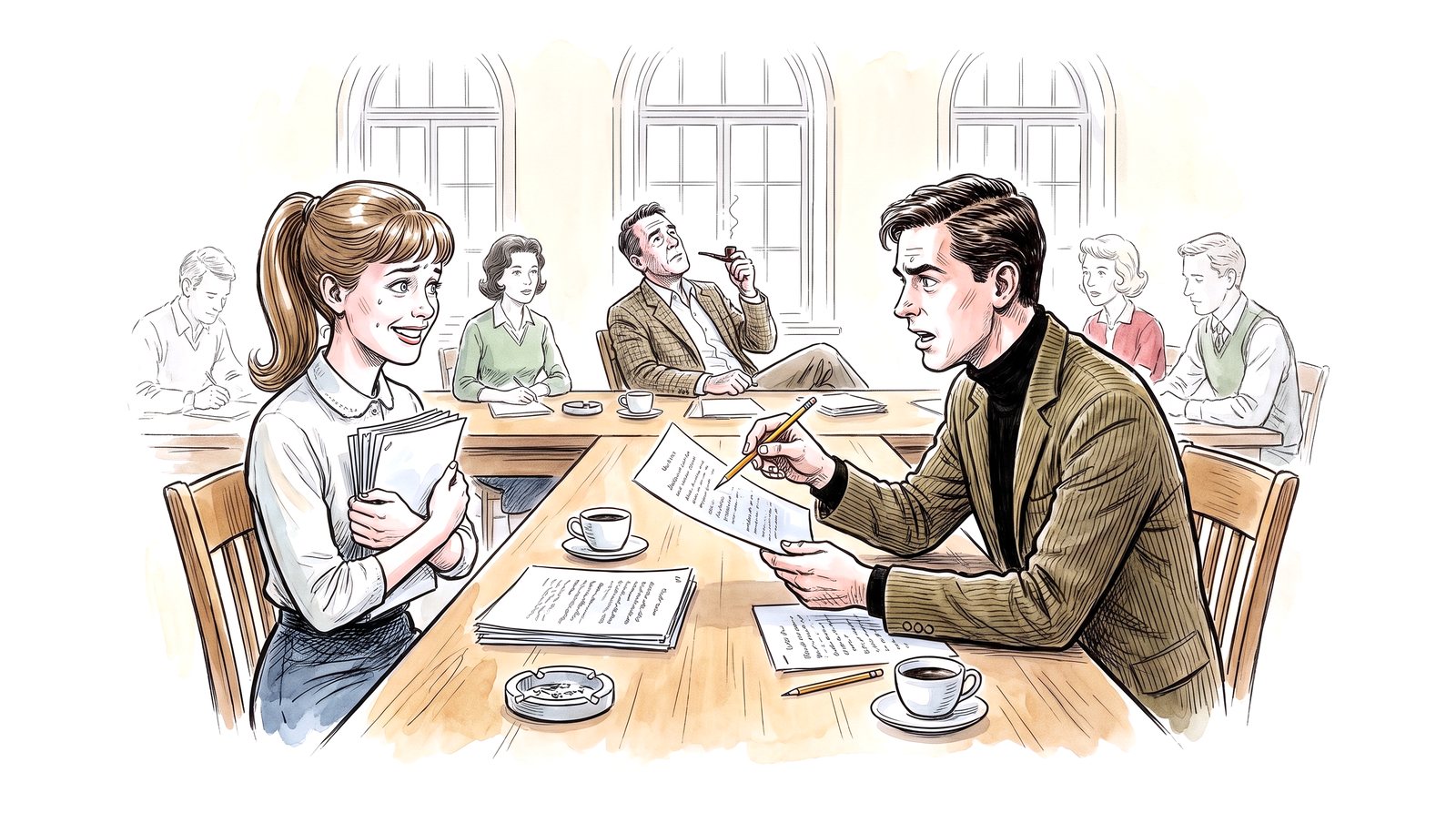
Your classmate has written a short story. You’ve read it twice. You have opinions.
Unfortunately, your professor would like you to share them.
You could compliment the dialogue. You could say the ending was interesting, a word that comes in handy when you have absolutely no idea what to say about an ending.
But you didn’t enjoy the whole story. The opening dragged. You couldn’t figure out what the main character wanted. And when you finished reading, you went back a few pages to see whether you’d missed something.
Now you have to explain all that while the person who wrote it sits six feet away.
Welcome to creative writing workshop.
You probably know when a story bores you, confuses you, or makes you want to keep reading. The trouble starts when someone asks you to explain why. That’s what we’re going to work on.
Start with what happened when you read it
Let’s say a classmate submits a short story called The Good Son.
Two brothers grew up working in their father’s family business. The younger brother took his share of the money and left town. The older brother stayed. He worked weekends, covered for his aging father, and eventually took over most of the business.
Years later, the younger brother comes home.
Their father is thrilled.
The older brother would prefer to be anywhere else.

The first three pages explain the family’s history. We learn when the business opened, what the brothers were like as kids, and why the younger one left.
On page four, the older brother arrives at work and discovers that his father has closed the business early to throw a party for his brother.
Finally, something happens.
Your first reaction might be, “The beginning was boring.”
Okay. What made it boring?
For three pages, you’ve been hearing about things that happened years ago. Then the older brother walks into work and finds out his father has made a decision that affects him. Now he has to do something about it.
Maybe that’s why page four caught your attention.
And maybe that’s worth mentioning to the writer.
Tell the writer what happened, not what to do
Here are three ways you could bring up the opening of The Good Son.
Version one: “The first three pages are boring.”
Well, that’s unpleasant. It also doesn’t tell the writer much.
Version two: “You should cut the first three pages and start on page four.”
Better, in the sense that you’ve identified something specific. But you’ve also decided how the writer should fix it. Maybe some of that backstory matters. Maybe the writer can work it into the action.
Version three: “I got interested when the older brother found out the business was closed. Before that, I felt like I was getting a lot of family history. I wonder if we could get to that moment sooner.”
That’s something the writer can work with.
You’ve pointed to a moment in the story and explained why it grabbed you. You’ve also suggested a possible change without insisting on it.
There’s nothing wrong with offering solutions in workshop. Sometimes another student’s idea is exactly what a story needs. But the writer gets to decide what belongs in the story.
Before you make a comment, try answering three questions:
- Where did something catch your attention?
- What did you feel or notice?
- Why do you think you reacted that way?
You won’t always have an answer to the third one. You might have to think about it for a while. That’s better than recommending a major rewrite because you got bored on page two.
Don’t mistake your preferences for problems
Back to our older brother.
He’s furious that his father has welcomed his irresponsible sibling home. He’s spent years keeping the business running, and now his father has shut the place down to celebrate the guy who left.
You can see why he’s upset.
You can also see why someone might think he’s being selfish. His brother has come home safe, and all he can think about is how unfair everything is.
Imagine a student in workshop says, “I didn’t like the older brother. He should be happier that his brother came home.”
But what if the writer doesn’t want you to like him?
Maybe the whole point is that his anger makes sense, even when his behavior doesn’t. Making him gracious and forgiving would solve the character’s problem by getting rid of the story.
Another student suggests making the father cruel and the younger brother a complete villain.
Sure. Then the older brother would be right about everything. There wouldn’t be much left to argue about.
If you want the younger brother to return with a stolen briefcase and a body in his trunk, congratulations. You have an idea for your own story.
Here’s a comment that might actually help:
“I understood why the older brother was angry, but I couldn’t tell whether I was supposed to agree with him. I wondered how you wanted readers to see him.”
The writer might say the uncertainty is intentional. Great. Now you know. Or the writer might realize the story isn’t coming across the way they hoped.
Either response gives you somewhere to go.
A character doesn’t have to be likable. A decision doesn’t have to be one you’d make yourself. And the fact that you wanted a different ending doesn’t automatically mean the writer chose the wrong one.
Compliments need evidence, too
You don’t need to find two nice things to say before you’re allowed to criticize something. This isn’t an employee performance review.
But if something works, tell the writer what worked.
Let’s say The Good Son includes a scene in which the older brother stays at the family business while everyone else gets ready for the party.
His father has left a handwritten note on the counter:
Lock up when you’re finished.
The older brother folds the note and puts it in his pocket.
You could say, “I liked that scene.”
Fine. But what did you like about it?
Maybe it’s the way the father assumes his older son will take care of everything, as usual. He doesn’t even think to ask. And the older brother keeps the note, which makes you wonder whether he’s saving it as proof of something he’ll never say out loud.
So tell the writer:
“The note on the counter really worked for me. His father just assumes he’ll close up, and the fact that he keeps the note made me think it hurt him more than he wanted to admit.”
That’s the sort of thing a writer might not realize is coming through.
And if they revise the story, they’ll know that detail is worth keeping.
What if you know something’s wrong but can’t explain why?
Sometimes you finish a story and something bothers you, but you can’t quite put your finger on it.
Near the end of The Good Son, the older brother finally confronts his father. They argue about the business, the younger brother, and everything the older son has done for the family.
The father invites him to come to the party.
The older brother walks away.
End of story.
You don’t like the ending. But why?
Maybe you expected him to tell his father what he’d sacrificed. Maybe you thought he’d finally speak to his brother. Or maybe you just wanted some clue about what walking away meant.
Is he refusing to forgive his brother? Is he done working for his father? Is he leaving the family altogether?
You don’t need to answer those questions for the writer. You can ask them.
“When he walked away, I wasn’t sure what he was deciding. Was he rejecting his brother, or was he finally choosing to leave the business?”
Maybe the writer wants both possibilities hanging there. Maybe they hadn’t thought about the distinction.
Either way, it’s a better discussion than telling them the ending needs more work.
And it’s perfectly fine to begin a workshop comment with “I might have missed something, but…”
Just make sure you follow it with an actual question.
How to say it when the writer is sitting across from you
Writing comments in the margins is one thing. Saying them out loud is another.

Now everyone is looking at you, including the author, who’s spent the last fifteen minutes listening to classmates debate whether the older brother in The Good Son is an insufferable brat.
You don’t need to make some grand pronouncement about the story.
You can respond to what someone else said.
Suppose a classmate says, “I thought the older brother was selfish. His father doesn’t owe him a party just because he stayed.”
You might say:
“I read that differently. I didn’t think he wanted a party. I thought he wanted his father to notice how much he’d done. The note on the counter made me think that.”
Now there’s something for the class to discuss.
If another student disagrees, explain what in the story led you to your interpretation. They may have noticed something you missed. Or you may have noticed something they missed. You don’t need to convince them.
And please don’t turn the workshop into a five-minute lecture about what the author obviously meant. Unless you wrote the story, you don’t know.
Your professor will have rules for how the workshop runs. In some classes, the writer can answer questions as the discussion goes along. In others, the writer stays quiet until the end. Follow whatever system you’re given.
The same goes for how you phrase criticism. There’s no prize for being the harshest person in the room.
“The father felt underdeveloped to me because I didn’t understand his relationship with the older son” gives the writer something to think about.
“The father was badly written” mostly tells the writer you didn’t like him.
You can be direct without making it personal.
Give the writer something they can use
By the end of workshop, the author of The Good Son may have heard that the older brother is sympathetic, selfish, compelling, irritating, and possibly the only person in the family with any sense.
Somebody will want a different ending.
Somebody will want more backstory.
Somebody will suggest cutting the backstory that somebody else wants expanded.
The writer will have to sort through all of that later, probably while wondering why they signed up for this class.
Your part is simpler.
Tell them where you got interested. Where you got confused. Which details stuck with you. What you wanted to know that the story never told you.
Give them a reason to look at something again.
Then let them get back to work.