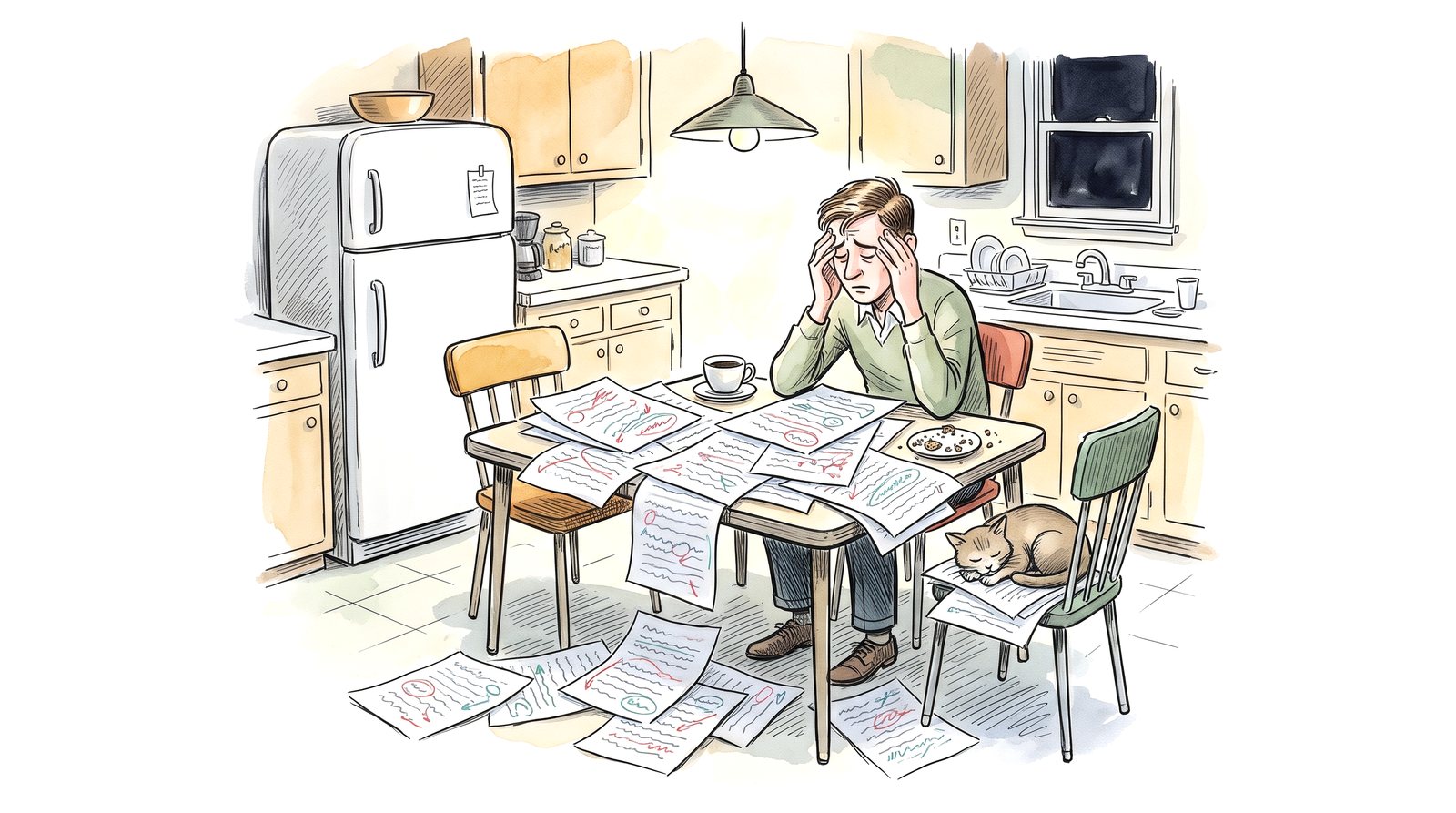
Your creative writing workshop is over. You’ve survived an hour of classmates discussing your short story while you sat there pretending to take notes instead of mentally defending every decision you’ve ever made. Now you’re home with twelve marked-up copies of your manuscript, a notebook full of comments, and a headache.
Three people thought the opening was too slow; two loved it. One classmate couldn’t stand your protagonist, while another thought he was the best part of the story. Someone suggested a flashback. Someone else wanted you to cut all the flashbacks, which would be easier if you’d written any in the first place. Your professor offered the encouraging assessment that there was “some good material here.”
You open the manuscript, ready to make changes, and immediately run into a problem: which changes? Writers sometimes treat workshop feedback as a list of corrections, working through every complaint as though a classmate’s suggestion were a teacher’s mark in the margin. But twelve people can read the same story and imagine twelve different versions of what it ought to be. You can’t write all twelve, and you probably shouldn’t try.
Your classmates noticed something. That doesn’t mean they know how to fix it.
Suppose you submitted a short story called The Good Son. Two brothers grew up working in their father’s family business. The younger one left town years ago with his share of the money; the older one stayed, worked weekends, and eventually took over most of the business. Now the younger brother has come home. Their father is delighted, but the older brother isn’t.
The story spends three pages explaining the family’s history before the older brother arrives at work and discovers that his father has closed the business early for a welcome-home party. Several classmates say they struggled to get through the opening. One recommends cutting those first three pages and beginning with the closed business. Another wants more information about why the younger brother left. A third suggests a childhood scene showing the brothers together.
The author dutifully writes down all three suggestions, then goes home to figure out how to follow them. Apparently the answer is to cut the opening, add more backstory, write a childhood scene, and somehow make the beginning shorter. Good luck with that.

Underneath those contradictory instructions, though, is something worth investigating. Readers are interested in the brothers’ relationship, but the story isn’t giving them enough reason to care before the conflict begins. They may be right about the problem even if none of their proposed fixes is right for the manuscript. A reader can spot a genuine weakness and suggest a terrible solution; another can suggest an elegant change to something that wasn’t broken. Learning to separate the observation from the prescription is the useful part of workshop.
Separate the criticism from the suggestion
When you return to your workshop notes, look for three different kinds of comments.
1. Observations
These are things readers experienced while reading your story. They got confused about the timeline. They lost interest during a particular scene. They didn’t understand why a character made an important decision.
2. Solutions
These are things readers think you should change. Cut the opening. Add a flashback. Change the point of view. Give the protagonist a different motivation.
3. Preferences
These are things readers wish your story had been. More romance. Less dialogue. A happier ending. A detective.
Preferences can be especially entertaining. Someone reads your quiet literary story about two estranged brothers and suggests that the younger brother should have returned home because he’s being pursued by the mob. Maybe that would be a terrific story, but it isn’t necessarily yours.
Still, don’t dismiss the suggestion outright. The reader may have wanted more tension or a stronger reason for the younger brother’s return. That’s a reaction worth considering, even if the proposed solution belongs in another genre.
Let’s look at three comments the author of The Good Son might have received.
Comment one: “I didn’t get interested until the older brother found out his father had closed the business.”
That’s an observation. The reader has identified the moment the story became compelling.
Comment two: “You should start on page four and work the family history into the dialogue.”
That’s a proposed solution. It might work. But the writer needs to understand why the opening failed before deciding whether to cut it.
Comment three: “I wish the younger brother had come back to steal the business.”
That’s a preference. The reader has imagined a different conflict.
Notice that the first two comments may describe the same problem, while the third may not identify a problem at all. Writers often give suggestions more weight than observations because suggestions sound actionable. “Cut the first three pages” is an instruction you can follow immediately. “I didn’t get interested until page four” requires you to ask why: Was that where the conflict began? Was there a surprise? Did the older brother finally have something to react to?
Those questions take longer to answer, but they’re more likely to lead to a useful revision. You don’t have to reject your classmates’ ideas. Just don’t mistake their confidence for certainty.
What if everyone disagrees?
Workshop discussions can produce completely opposite reactions to the same passage. One reader thinks your protagonist is selfish; another finds him sympathetic; a third thinks he’s both. Meanwhile, somebody in the back is worrying about what everyone will say when it’s their turn.
In The Good Son, the disagreement might center on the older brother. He’s spent years keeping the business alive while his younger sibling was away, and now their father has closed it to celebrate the younger son’s return. Some readers understand his anger. Others think he ought to be happy his brother is home. Before changing anything, the author needs to decide what the story is asking readers to understand.
Maybe the older brother is meant to be difficult. If readers understand his resentment without entirely approving of his behavior, the disagreement could mean the characterization is working. But if several readers think he’s angry merely because his father closed the business for an afternoon, the story may not have established the years of resentment behind his reaction. That’s a problem of context, not likability.
A workshop isn’t an election. You don’t count votes, declare the majority correct, and rewrite accordingly. Eight readers might miss something that one reader catches, and an unexpected interpretation might reveal a possibility the author hadn’t considered. Listen to the reactions, look for evidence in the manuscript, and make a judgment about what serves the story. It’s considerably less satisfying than taking a vote, but that’s the job.
Decide what deserves another look
By this point, the author of The Good Son has notes about the opening, the older brother’s personality, the family history, and the ending. Some comments contradict one another; others are different ways of describing the same concern. Addressing every note would be a mistake. A better approach is to test each concern against three questions.
What did the reader actually experience?
Focus on what happened during the reading, rather than what the reader suggested changing. Did they get bored, confused, or surprised? Were they waiting for something that never happened? Describe the reaction before proposing a fix.
Does that reaction point to a problem in the manuscript?
Sometimes it does. If several readers lose interest during the opening, there’s probably something worth examining. But if one reader dislikes the older brother because he’s resentful and unpleasant, that might be exactly the response the author intended. The distinction depends on what the story is trying to accomplish.
Would fixing this make the story better?
This is where the writer has to exercise judgment. Cutting three pages of exposition might make The Good Son more engaging, but removing the family history altogether could leave readers unable to understand the brothers’ relationship. Making the older brother more agreeable might win over a few classmates while stripping away the tension that makes him interesting.
The author might decide that the opening needs work, the older brother’s characterization is largely doing its job, and the ending deserves another look. Take the opening: rather than spending three pages on family history, the story could begin closer to the moment the older brother discovers the business is closed. The conflict arrives sooner, and the necessary history can emerge as the brothers’ relationship unfolds.
That decision doesn’t require a childhood flashback, a more agreeable protagonist, or the wholesale removal of the family’s past. It responds to a specific weakness without trying to satisfy every classmate who offered an opinion. The author has moved from collecting criticism to making an editorial decision. That’s progress.
It’s still your story
A good workshop can reveal things you couldn’t see in your own manuscript: a character’s motivation that isn’t coming through, a scene that doesn’t accomplish what you thought it did, or a small detail you almost cut that everybody remembers. Those reactions are valuable, but your classmates aren’t writing the story. You are.
You can take criticism seriously without adopting the suggested fix. You can disagree with a reader without dismissing what they experienced. You can even keep something people disliked, provided you understand what it’s doing in the story. The aim isn’t a second draft that pleases everyone who read the first; it’s a better version of the story you’re trying to tell.
Once you’ve decided which feedback matters, of course, there’s still the small matter of actually revising the thing.