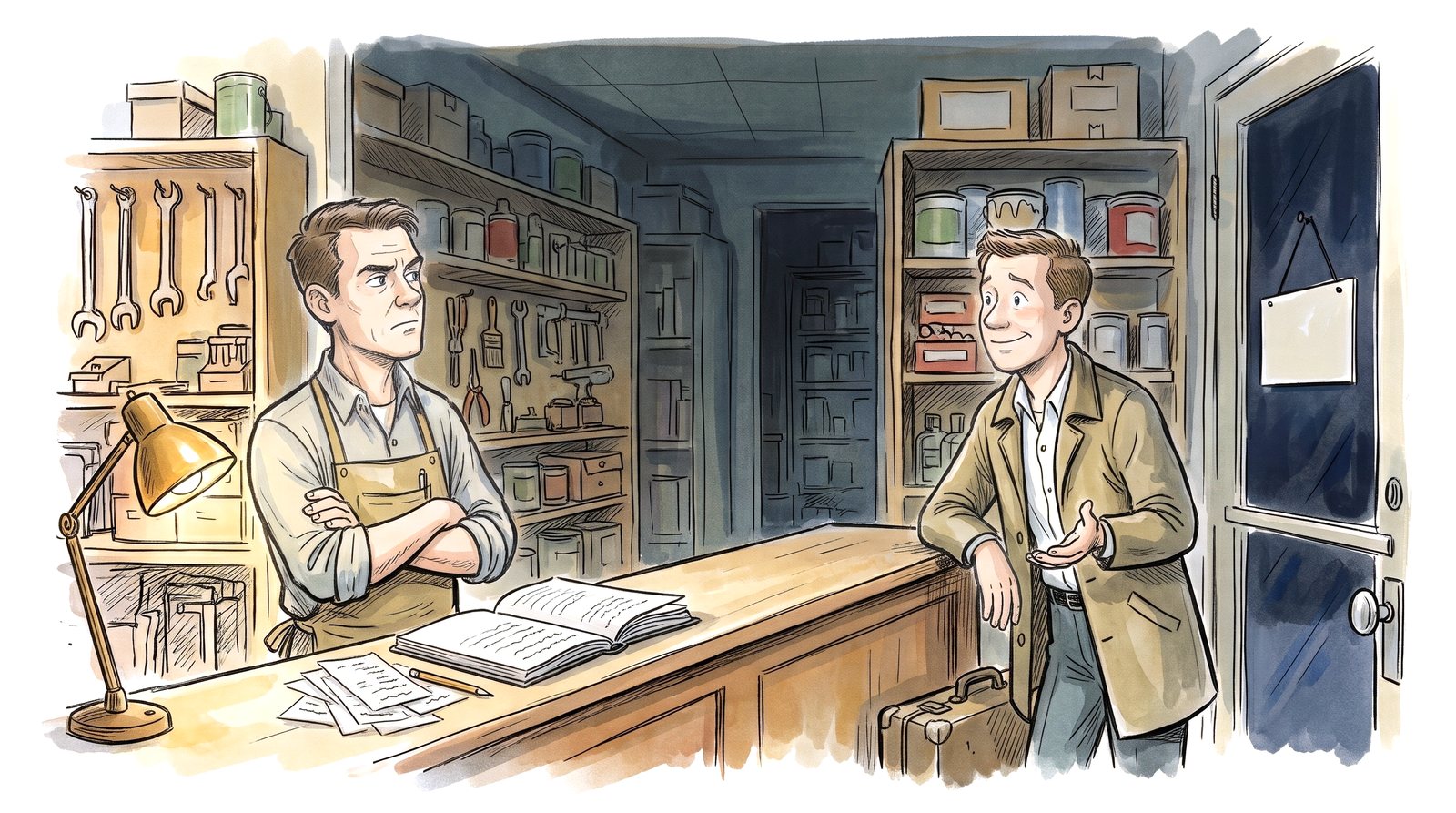
Two characters are having a conversation. One asks a question. The other answers it. They exchange a few observations, clarify a misunderstanding, and eventually agree on what happens next.
The dialogue sounds natural. Nobody delivers a speech. Nobody announces how they’re feeling. You can practically hear the actors saying the lines.
And somehow, the whole thing is boring.
This is one of the more frustrating problems in fiction writing because nothing is obviously wrong. The characters sound like people. The conversation makes sense. You’ve even remembered to break up the dialogue with a few gestures so nobody spends three pages standing perfectly still.
But a believable conversation isn’t necessarily an interesting one.
Think about the conversations you have every day. Most of them accomplish something practical. You ask whether anyone needs anything from the grocery store. Someone tells you the dishwasher is making a weird noise. You discuss what time to leave for dinner.
Perfectly realistic dialogue. Absolutely riveting stuff.
Fiction has different requirements. Readers don’t need to hear everything your characters might reasonably say. They need to hear the exchanges that reveal something, complicate something, or change something.
The problem isn’t that your dialogue sounds unrealistic.
It’s that nobody’s doing anything with it.
Give the conversation a reason to exist
Consider The Good Son, a fictional story about two brothers and their father’s family business.
The younger brother left town years ago, taking his share of the money with him. The older brother stayed. He worked weekends, helped their father as he got older, and eventually assumed most of the responsibility for keeping the business running.
Now the younger brother has returned, and their father couldn’t be happier. He’s even closing the business early to celebrate.
The older brother remembers something his father apparently doesn’t: when he asked to close early for his daughter’s birthday, the answer was no.
There’s plenty of conflict here. Imagine the brothers speaking privately after the younger one’s return.
“How’s business?” the younger brother asked.
“Good.”
“Dad says you’ve been busy.”
“Yeah. We’ve been busy.”
“That’s good.”
“Sure.”
“I heard you hired somebody.”
“Last spring.”
“How’s that working out?”
“Fine.”
Nothing about this exchange is unbelievable. Two brothers who haven’t seen each other in years might very well make awkward small talk about the family business.
But what have we learned that we couldn’t have learned from a sentence of narration?
The business is doing well. They hired somebody. The brothers aren’t particularly comfortable around each other.
That’s about it.
There’s nothing wrong with starting a conversation politely. Sometimes those first few harmless lines are exactly what make the next one sting. The problem isn’t small talk. It’s small talk that never becomes anything else.
And these brothers have plenty to say to each other. They’re just not saying any of it.

The younger brother wants to come home without being punished for leaving. He wants things to feel normal, or at least normal enough that he can enjoy the reunion.
The older brother wants somebody to acknowledge what staying cost him. He wants recognition for the weekends he worked, the family events he missed, and the responsibility he inherited while his brother built a life somewhere else.
Neither is particularly interested in giving the other what he wants.
The argument underneath the argument
Now imagine the same conversation when the older brother decides he’s had enough of pretending everything is fine.
“How’s business?” the younger brother asked.
“You’d know if you called.”
“I talk to Dad.”
“Yeah. I know.”
“What’s that supposed to mean?”
“Nothing.”
“You always do that.”
“Do what?”
“Say something and then pretend you didn’t.”
The older brother looked at him.
“How’s business?” he asked.
The younger brother has asked an ordinary question. His older brother has heard an insult.
For years, one has been responsible for keeping the business alive. The other has been free to ask about it occasionally. The older brother doesn’t appreciate the distinction, particularly when his brother seems unaware that one exists.
The younger brother, meanwhile, has made what he considers a reasonable attempt at conversation and received an accusation in return.
Their history changes the meaning of an otherwise harmless question. The older brother doesn’t need to explain that he feels abandoned. His reaction tells us. The younger brother doesn’t need to announce that he’s tired of being blamed for leaving. He immediately becomes defensive.
This is where subtext becomes useful. The characters are discussing the business, but their real disagreement concerns responsibility, resentment, and what one brother owes the other.
The tension comes from what each brother wants and what the other refuses to give him. One wants to be welcomed home without an interrogation. The other wants his sacrifices acknowledged. Neither can get what he wants without the other giving something up.
And neither wants to be the first to admit it.

People rarely present their emotional grievances in convenient packages. They deflect. They exaggerate. They bring up something that happened six years ago when somebody asks them to pass the salt.
They also have a remarkable ability to hear accusations in questions that, taken literally, contain none.
The writer’s job isn’t to make every line conceal some elaborate secret. It’s to understand why these particular characters would say these particular things to each other.
Two strangers could have the same conversation about business and mean absolutely nothing by it.
These brothers can’t.
Nobody owes anybody an answer
One of the easiest ways to flatten dialogue is to make every character cooperate with the conversation.
Someone asks a question. The other person answers. Someone raises a concern. The other person explains. Eventually, everyone has said what they needed to say.
That’s useful when you’re trying to schedule a dentist appointment. It’s considerably less useful when two characters have incompatible objectives.
The brothers have spent years developing different explanations for what happened to their family. Neither is especially eager to hear the other’s version.
“Dad says you’re thinking about expanding.”
“Maybe.”
“That’s great.”
“Is it?”
“What?”
“Nothing. Forget it.”
“Jesus. I can’t say anything right, can I?”
“You said expanding was great.”
“Because it is.”
“Then maybe you should come back and help.”
For the first time, the older brother has made something resembling a demand. He doesn’t ask outright, of course. That would mean admitting he needs something from the person he’s spent years resenting.
The younger brother recognizes the accusation immediately.
“I’ve got a job.”
“I know you’ve got a job.”
“So what do you want me to do?”
“Nothing.”
“Then why’d you say it?”
“Forget it.”
The older brother keeps insisting that nothing is wrong. He wants his brother to understand without having to ask. The younger brother wants an accusation he can actually defend himself against.
The more they try to get what they want, the less likely either seems to receive it.
A question can become an accusation. A compliment can sound patronizing. An attempt to change the subject can expose exactly what someone is trying to avoid.
Of course, not every exchange needs to be a verbal chess match. Sometimes a character really does want to know where the bathroom is.
But if your scene depends on two people wanting different things, don’t make them so accommodating that they resolve the disagreement before it has a chance to become interesting.
One line changes everything
The brothers could continue like this for another twenty pages. The older brother makes a pointed remark. The younger brother gets defensive. Somebody says to forget it.
Eventually, the reader probably will.
The conversation needs to go somewhere the brothers weren’t expecting.
“I didn’t make you stay,” the younger brother said.
“No. You didn’t.”
“Then stop acting like I did.”
The older brother shook his head.
“You think I wanted you to stay?”
“What?”
“You think I wanted you here?”
The younger brother stared at him. “That’s nice.”
“You got your money and left. I stayed. Somebody had to.”
“That’s what you keep telling me.”
“Because it’s true.”
“Then why are you so pissed at me?”
The older brother opened his mouth, then closed it.
His brother waited.
“Because Dad never asked me to stay,” he said.
“What?”
“He just assumed I would.”
“You could’ve left.”
“Yeah,” the older brother said. “I know.”
Until now, the younger brother has believed his older brother resented him for leaving. The older brother has spent years telling himself that staying was a responsibility he accepted because somebody had to.
But his resentment may have less to do with his brother’s departure than with their father’s expectations.
The younger brother has spent years defending his decision to leave against someone who may never have wanted him to stay.
And the older brother has finally acknowledged something uncomfortable: he had a choice, too.
Neither man has suddenly become wiser, kinder, or more forgiving. The older brother may regret what he’s said. The younger brother may have no idea how to respond.
But they can’t return to their original argument quite so easily.
A conversation doesn’t need to end with a dramatic revelation or a slammed door. Sometimes the change is smaller and more uncomfortable. Someone realizes they’ve misunderstood another person. Someone admits something they’ve been avoiding. Someone asks a question that can’t be answered without making things worse.
The exchange leaves the characters with something they didn’t have when it began.
Even if neither of them particularly wanted it.
Make the conversation earn its place
Find a dialogue-heavy scene in your draft that feels flat, even though the characters sound reasonably believable.
Before rewriting it, ask yourself one question: What changes because these characters have this conversation?
Maybe somebody admits something they’ve been hiding. Maybe an innocent question exposes an old resentment. Maybe a character hears something they weren’t prepared to hear.
The change doesn’t need to be dramatic. But the conversation should leave somebody in a different position than when it began.
Otherwise, you might have written a perfectly realistic exchange that your story doesn’t actually need.
Characters can joke, flirt, comfort each other, or talk about something apparently trivial. Those exchanges can still reveal relationships, deepen our understanding of the characters, or prepare us for something that happens later.
But the conversation needs to earn the space you’re giving it.
Real people talk to fill silence, pass time, exchange information, and avoid uncomfortable subjects. Fictional characters can do those things, too.
The difference is that you’ve chosen which conversations the reader gets to hear.
Make that choice count.